

An Overview of California ADA Signage Requirements
By Mike Shabluk | February 27, 2024
There are many guidelines for designing, manufacturing, and mounting ADA signs. Businesses must comply with federal regulations as well as state and local requirements. For California-based facilities and the sign professionals who serve them, understanding California ADA restroom sign requirements is especially important.
The challenge is that California’s rules go beyond federal ADA standards. Fortunately, this overview breaks down the key requirements and explains how Title 24, AB 1732, and federal ADA regulations work together. With a solid understanding of these requirements, you can make informed signage decisions and help ensure compliance.
Why You Should Know California ADA Restroom Sign Requirements
Whether you’re purchasing signage for your own facility or sourcing signs for a client, understanding California ADA restroom sign requirements is critical.
Compliance issues can lead to costly corrections, legal disputes, project delays, and unhappy customers. A clear understanding of the rules makes compliance easier and helps reduce risk.
California has long maintained restroom signage requirements that are more specific than those found in many other states. As a result, facilities often need signage that satisfies both state and federal standards.
For California ADA signage, several regulations come into play:
- California AB 1732 (The Equal Restroom Access Act)
- Title 24 of the California Building Code
- 2010 ADA Standards for Accessible Design
However, compliance is about more than following regulations. These requirements help make facilities more accessible, intuitive, and welcoming for everyone who uses them.
The regulations themselves can be lengthy and complex, so facility owners, architects, contractors, and sign professionals are encouraged to review the official standards whenever possible. In the meantime, a practical overview can help clarify the basics.
Before diving into the specific restroom signage requirements, it helps to understand where these rules came from.
How Were California ADA Restroom Sign Requirements Created?
California restroom signage requirements actually predate the Americans with Disabilities Act.
The concept originated in the 1970s with inventor and mathematician Samuel Genensky. Having severe visual impairment himself, Genensky understood the difficulty many people experienced when trying to locate the correct restroom. He proposed using large geometric symbols that would be easier to identify visually and tactually.
His idea gained traction throughout California.
Women’s restrooms began using a 12-inch circle, while men’s restrooms were identified by a 12-inch equilateral triangle.
When the ADA was passed in 1990, federal restroom signage requirements were introduced nationwide. Rather than abandoning the symbols Californians had used for years, the state chose to retain them while also adopting federal ADA requirements.
As a result, California facilities must comply with both federal ADA standards and California-specific restroom signage regulations.
What Are the Requirements for Bathroom Signs in California?
At the federal level, the ADA generally requires one compliant sign to identify a public restroom.
In California, public restrooms typically require two signs:
- A geometric door sign that complies with California requirements.
- A tactile ADA wall sign that complies with federal requirements.
The California-required geometric symbols generally do not contain braille, text, or pictograms. Instead, they rely on shapes that have been familiar to California residents for decades.
Outside of California, these geometric restroom symbols are uncommon because most states rely solely on federal ADA signage standards.
Quick Compliance Summary
Most California public restrooms require:
- A Title 24 geometric symbol mounted on the door
- A tactile ADA sign with braille mounted on the adjacent wall
- Proper mounting heights for both signs
- Compliance with any applicable local code requirements
How Title 24 Guidelines Come into Play
California ADA restroom sign requirements are outlined within the California Building Standards Code.
Under Title 24, public restroom doors must display specific geometric symbols that meet the following requirements:
- Men’s restrooms must display a 1/4-inch-thick equilateral triangle with 12-inch edges.
- Women’s restrooms must display a 1/4-inch-thick circle with a 12-inch diameter.
- The symbol must contrast with the color of the door.
- Unisex restrooms must display a triangle superimposed on a circle using contrasting colors.
- Edges must be rounded, eased, or chamfered according to Title 24 specifications. Vertices must also meet the required radius dimensions.
A pictogram indicating restroom use may be included on the geometric sign. While tactile pictograms are not required, they are often incorporated into sign designs.
How AB 1732 Guidelines Come into Play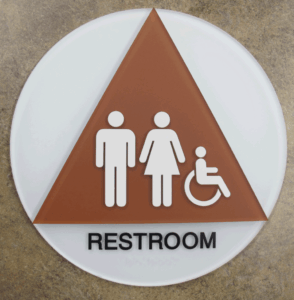
California Assembly Bill 1732, also known as the Equal Restroom Access Act, took effect in 2017.
The law was designed to improve access and reduce discrimination related to gender identity. Under AB 1732, all single-occupancy restrooms in public facilities must be identified as all-gender restrooms and be available to everyone.
As a result, signage requirements changed for these spaces.
For single-user restrooms:
- The door sign must feature a 1/4-inch-thick equilateral triangle within a 1/4-inch-thick circle.
- Mounting requirements remain consistent with other California restroom signs.
It’s also important to remember that local jurisdictions may enforce additional signage requirements. Always verify project-specific requirements with the appropriate authority having jurisdiction.
How Do California Requirements Differ from Federal Guidelines?
In simple terms, California requirements and federal ADA requirements govern different signage elements.
California regulations primarily address the geometric symbol displayed on the restroom door. Federal ADA regulations primarily address the tactile sign mounted adjacent to the restroom entrance.
Regardless of state-specific rules, all facilities must comply with federal ADA standards.
Federal ADA restroom signs typically require:
- Tactile lettering that identifies restroom access
- Grade 2 braille positioned beneath the tactile text
- California-compliant braille spacing requirements where applicable
- The International Symbol of Accessibility when identifying an accessible restroom
Installation requirements also differ.
Under federal ADA standards, restroom identification signs are typically mounted on the wall adjacent to the latch side of the door. The sign should be installed between 48 and 60 inches above the finished floor, measured to the baseline of the lowest braille cell.
California geometric restroom signs follow a separate standard.
The geometric symbol must be centered horizontally on the door and mounted between 58 and 60 inches above the finished floor, measured to the symbol’s centerline.
The same placement rules apply to the all-gender restroom symbols required under AB 1732.
When Can You Use a Dual-Purpose Restroom Sign?
Most California restrooms require both a geometric door sign and a tactile wall sign.
However, there are limited situations where a dual-purpose sign may be acceptable. For example, some restrooms with curved entrances instead of doors may allow a combined solution.
In other cases, all of the following conditions generally must be met:
- The door cannot have a hold-open device.
- The door must close automatically.
- The sign must be installed on the push side of the door.
If these conditions are satisfied, a dual-purpose sign that complies with both state and federal requirements may be permitted.
Before proceeding, it is always wise to confirm approval with the local building official or authority having jurisdiction.
Takeaway
California restroom signage requirements combine state-specific rules with federal ADA standards. That means compliance involves more than selecting a standard ADA restroom sign.
Most facilities must provide both a California-compliant geometric door sign and a federally compliant tactile wall sign. In addition, projects may need to account for Title 24 requirements, AB 1732 all-gender restroom rules, mounting specifications, and local code requirements.
For sign shops, architects, contractors, and facility managers, understanding these standards early in the project can help prevent costly revisions and compliance concerns later.
If you’re sourcing restroom signage that meets California requirements, Erie Custom Signs offers a range of California restroom sign solutions designed to help trade professionals navigate these unique requirements with confidence.
Learn more about our California restroom sign options and find the right solution for your next project.
FAQ
Do California restrooms require two ADA signs?
In most cases, yes. California public restrooms typically require a geometric door sign that meets Title 24 requirements and a tactile wall sign that meets federal ADA requirements.
What symbol is required for a men’s restroom in California?
California Title 24 requires a 12-inch equilateral triangle that is 1/4 inch thick and contrasts with the door color.
What symbol is required for a women’s restroom in California?
Women’s restrooms require a 12-inch diameter circle that is 1/4 inch thick and contrasts with the door color.
What does AB 1732 require?
AB 1732 requires single-occupancy public restrooms to be identified as all-gender restrooms and accessible to all users.
Where should California restroom door signs be mounted?
Geometric restroom symbols must be centered horizontally on the door and mounted between 58 and 60 inches above the finished floor, measured to the centerline of the symbol.